
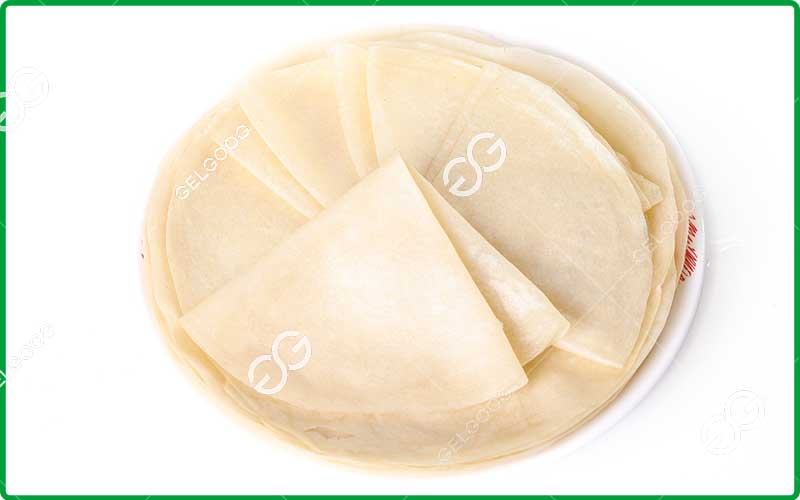
Spring Roll Wrapper Production Process Guide
Spring roll wrappers need to be thin, flexible, uniform, and strong enough to hold fillings without tearing. For commercial food manufacturers, achieving this consistency with manual production becomes difficult as demand increases.
An industrial spring roll wrapper production process combines batter preparation, controlled heating, sheet forming, cooling, cutting, and stacking into a continuous workflow. Understanding each stage helps manufacturers select the right equipment and establish stable production standards.
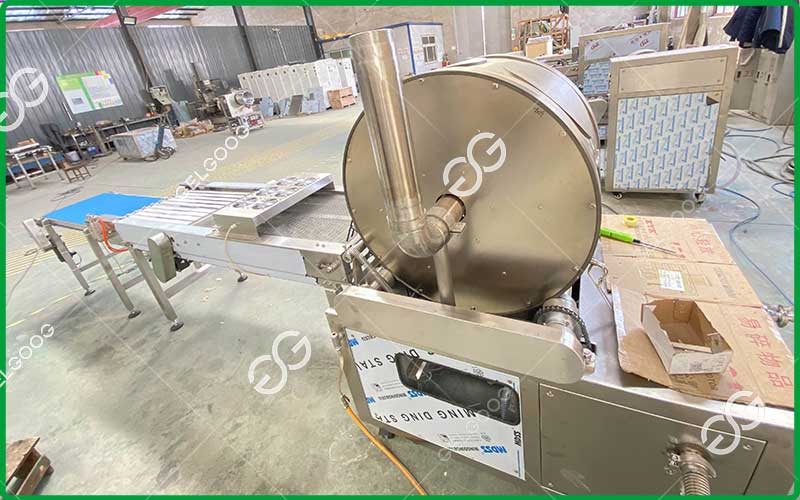
What Is the Spring Roll Wrapper Production Process?
The basic commercial process can be summarized as:
Flour & Water → Batter Mixing → Batter Feeding → Heating & Forming → Wrapper Separation → Cooling → Cutting → Counting & Stacking
This process converts a prepared flour-based batter into thin pastry sheets with controlled dimensions and thickness.
For factories, automation can reduce manual handling and improve consistency between batches. Modern wrapper equipment can also support different sheet sizes, shapes, and thickness settings depending on the production requirement.
What Should Manufacturers Control?
1. Wrapper Thickness
Thickness affects flexibility, cooking performance, and tear resistance, and different products may need different specs. Industrial equipment offers adjustable thickness settings—for example, GELGOOG's wrapper equipment supports roughly 0.3–2.0 mm depending on configuration.
2. Sheet Size and Shape
Wrappers can be square, round, or custom-shaped, so required dimensions should be decided before choosing a cutting system. Consider both wrapper size and final application—frozen spring rolls, fresh products, catering packs, or further processing.
3. Production Capacity
Match capacity to actual demand rather than simply picking the largest machine. Different configurations cover roughly 1,000 pcs/h to several thousand pieces per hour. When calculating capacity, also factor in operating hours, product specs, changeover time, and packaging requirements.
How to Choose Equipment for Consistent Production
When comparing industrial spring roll wrapper production equipment, buyers should evaluate more than the headline output.
Consider these questions:
- What wrapper size and thickness are required?
- How many pieces per hour does the factory need?
- Will the machine run continuously or in batches?
- Is electric or gas heating more suitable for the facility?
- Does the production system include cooling, cutting, and stacking?
- Can the equipment be adjusted for future product specifications?
For manufacturers producing lumpia, spring rolls, crepes, or similar thin pastry sheets, selecting flexible equipment can help improve equipment utilization.
If your factory requires equipment for consistent lumpia wrapper production, a dedicated wrapper system can integrate batter feeding, heating, forming, cooling, cutting, and stacking into a more standardized workflow.
Conclusion
A reliable spring roll wrapper production process depends on consistent batter preparation, controlled heating, uniform sheet formation, effective cooling, accurate cutting, and stable stacking.
For food manufacturers planning commercial production, the right equipment should match the required wrapper specifications, capacity, heating method, and future product range. A well-designed automated workflow can provide a more repeatable production process while reducing unnecessary manual operations.
Leave a Reply